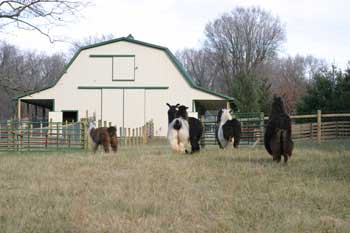
Female llamas are induced ovulators, meaning that release of a mature ovum for fertilization is induced by copulation. They do not have an estrus, or heat, cycle. Llamas can be breed any time of year, although breeders prefer to avoid births occurring during the extreme heat and humidity of summer, or during the severe winter months.When the male llama approaches an open female, she may initially resist his advances, but then she will lie down in a kushed position for him to mount her.Actually breeding can last from 5 minutes to over an hour, with 20 minutes about typical. The male will release semen slowly during the course of the breeding. Approximately 7 days after successful impregnation, the female will resist the advances of the male, often to the point of “spitting-off.” Occasionally open females will spit-off a male, and pregnant females may lie down and allow the male to mate. Due to this variability, behavior is not always a conclusive indicator of pregnancy. Breeders can take advantage of progesterone level testing and ultrasounds to reliably determine pregnancy or the source of breeding problems.
Category Archives:
Most common is the four foot high woven wire cattle fence. While adequate in many situations, this fencing is not impenetrable to predators, who can dig under or climb/jump over the fence. Llamas can also jump a four to five foot tall fence, although they usually won’t unless being pursued, or while trying to reach a companion, or even just to get to better grazing (the grass is always greener….) An electric wire run low to the ground around the outside can help in preventing dogs from digging under the fence. Stud males may required more substantial or taller fencing, as they are more tempted to jump to reach females or “climb” the fence to display to other males.New-Zealand style high-tensile fencing is an economical, attractive, long-lasting fence. However, it needs to be electrified to resist predators. If a llama reaches through or tries to jump the electric wire and becomes entangled, death will almost certainly result from disruption of the electrical path in the heart. Therefore, use of this type of fencing should be carefully considered.
Special care should be taken when separating mothers from their babies during weaning. The baby may do everything within its power to jump, crawl around, under, or through any fencing to return to its mother, with potentially deadly results.
Remember that no fence is completely predator-proof; as can be sadly attested to by many llama owners who have lost llamas to roaming dogs, and even neighbor’s pet dogs.
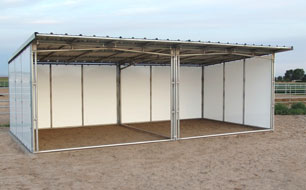 Housing for llamas can be simple sheds to elaborate barns. The basic winter requirements are shelter from inclement weather (rain, snow) and wind protection, which can be provided by as little as a three-sided shelter with the open side facing away from the prevailing wind. More substantial shelter may be required during severe (below zero degrees Fahrenheit or colder) or prolonged cold spells. Supplemental heat is rarely required for healthy adult llamas in US climates, although a thick bed of straw will add considerably to the llamas’ heat retention capabilities.While the simple shelter is necessary to protect from rain, the added danger of summer heat requires a source of shade in a well-ventilated area. Shearing of the llamas’ wool, the use of fans, and small ponds of cooling water (such as kids’ plastic wading pools) can be invaluable in reducing the risk of heat stress. In most US climates, the danger of heat stress in summer is far greater than danger from cold conditions in the winter.